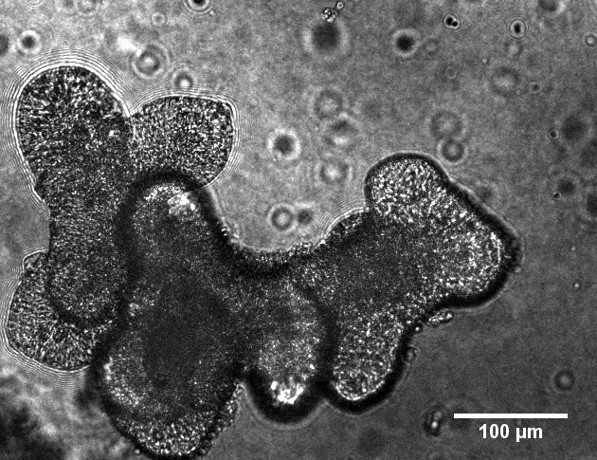
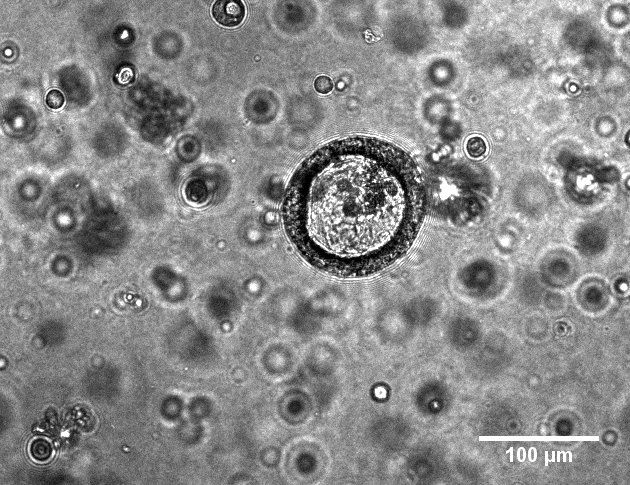
Unsere Arbeitsgruppe befasst sich mit der Etablierung und Anwendung intestinaler Organoide des Schweins zur Bearbeitung relevanter tiermedizinischer Fragestellungen direkt am speziesspezifischen Modell. Dabei dient das Organoidmodell nicht nur als translationales System für die Humanmedizin, sondern insbesondere auch zur Erforschung krankheitsrelevanter Prozesse beim Schwein selbst – einer der weltweit bedeutendsten Nutztierarten.
Organoide sind miniaturisierte, gewebetypische Strukturen, die aus adulten Stammzellen gewonnen werden und die Architektur sowie Funktion ihrer Ursprungsorgane widerspiegeln. In unserem Labor werden Organoide aus dem Dünn- (Jejunum) und Dickdarm (Colon) des Schweins kultiviert – sowohl von Bundeshybridschweinen als auch von der alten Rasse Bunte Bentheimer.
Forschungsschwerpunkte
- Etablierung intestinaler Organoide vom Schwein (Jejunum und Colon)
- Vergleich verschiedener genetischer Hintergründe durch Nutzung moderner Rassen und alter Haustierrassen
- Weiterentwicklung zu 2D-Modellen zur Anwendung funktioneller Messmethoden
- Verwendung der Ussing-Kammer-Technik zur Analyse von Barriere-, Sekretions- und Resorptionsprozessen
- Infektionsmodelle für enteropathogene Bakterien, z. B. Brachyspira hyodysenteriae
- Analyse genetischer und funktioneller Reaktionen des Epithels unter kontrollierten Bedingungen
Laufende Projekte
Integrated Organ-on-Chip and Digital Twin Platform for Systemic Assessment of Chemicals and Biomaterials
PhD-Projekt – Sarah Lüthje, M. Sc.
INTEGRA will establish a next-generation, animal-free platform for the systemic, physiology-informed safety and exposure assessment, combining integrated organ-on-chip (OoC) technologies, Digital Twin (DT) and AI tools. Current New Approach Methodologies (NAMs) model single organs or
weakly connected systems and do not adequately capture the dynamic interplay between gut absorption, liver metabolism, kidney clearance, barrier function, systemic redistribution, and distal effects on the brain. INTEGRA addresses this gap through a modular, physiology-based NAM linking gut,
brain, liver, and kidney modules in a recirculating microfluidic architecture with real-time sensing. The project will validate this framework using pesticides and advanced (nano)materials selected for their regulatory relevance significance.
INTEGRA follows a staged translational strategy. It will establish and validate standalone murine OoC modules and their single-organ DT, integrating them into a multi-organ murine platform benchmarked against targeted in vivo data. Thus, the project will develop a human multi-organ platform
based on iPSC-derived OoC modules, organoids, and 3D-bioprinted tissues, coupled to a human DT calibrated with project-generated multimodal data and anchored to biomarkers from exposed human cohorts. This approach will deliver predictive, mechanistically interpretable, and transferable tools for evidence integration and prioritisation.
Generating validated modules, reusable SOPs, benchmark datasets, FAIR data assets and uncertainty-aware DT workflows, INTEGRA will strengthen regulatory confidence, support faster and more human-relevant safety assessment, and contribute to reducing reliance on animal testing. Beyond its demonstration case, the platform is designed for broader use in chemical safety, biomaterials assessment, and preclinical research.
In vitro virulence monitoring of Brachyspira species in intestinal organoids of different pig breeds
PhD-Projekt – Masina Plenge, M.Sc.
Ziel dieses Promotionsprojekts ist es, die Interaktion verschiedener Brachyspira-Stämme mit intestinalen Organoiden des Schweins zu untersuchen. Dabei werden sowohl pathogene als auch weniger virulente Isolate getestet und der Einfluss genetischer Unterschiede zwischen Schweinerassen berücksichtigt. Das Projekt trägt dazu bei, den Pathomechanismus von Brachyspira-Infektionen besser zu verstehen und neue Ansatzpunkte für die Reduktion von Antibiotikaeinsatz in der Schweinehaltung zu identifizieren.
Impact of cultivation conditions and Brachyspira infections on gene expression and epithelial function in porcine colon organoids
Masterarbeit – Felizitas Elma, B.Sc.
Diese Masterarbeit untersucht, wie unterschiedliche Kultur- und Interface-Bedingungen in einem porzinen Colon-Organoidmodell die epithelialen Reaktionen auf Infektionen mit Brachyspira beeinflussen. Die Arbeit legt damit wichtige Grundlagen für die Standardisierung physiologisch relevanter Infektionsmodelle.
Publikationen (Auswahl)
- Hoffmann P. et al. (2021). Intestinal organoid-based 2D monolayers mimic physiological and pathophysiological properties of the pig intestine. PLoS ONE. DOI: 10.1371/journal.pone.0256143
- Benz P. et al. (2025). Two-dimensional Porcine Intestinal Organoids Reflecting the Physiological Properties of Native Gut. JOVE. DOI: 10.3791/67666
- Plenge M. et al. (2025). Development and characterization of a 2D porcine colonic organoid model for studying intestinal physiology and barrier function. PLoS ONE. DOI: 10.1371/journal.pone.0312989
Kooperationen
- TiHo Hannover – Institut für Mikrobiologie
- Medizinische Hochschule Hannover (MHH)
- Helmholtz-Zentrum für Infektionsforschung (HZI)
- Weitere nationale und internationale Partner im Bereich Zoonosenforschung, 3R-Modelle und Tiergesundheit
Team
- Pascal Benz, PhD – Wissenschaftliche Leitung & Projektkoordination
- Sarah Lüthje, M.Sc. – Doktorandin
- Nadine Schnepel, BTA – Technische Mitarbeiterin
Kontakt
Für wissenschaftliche Kooperationen, Projektideen oder Fragen zur Organoidforschung:
Pascal Benz, PhD
Institut für Physiologie und Zellbiologie, TiHo Hannover
✉ pascal.benz@tiho-hannover.de