Why do viruses affect female and male brains differently?
Since 1 October 2026 the German Research Foundation (DFG) has been funding our project DIVA – Sex-dimorphic immune signalling in astrocytes upon viral challenges – within the new Priority Programme SPP 2561 “SEX and GLIA”. DIVA is a collaboration between Prof. Dr. Franziska Richter Assencio and Dr. Christopher Käufer (Department of Pharmacology, Toxicology and Pharmacy, TiHo) and Prof. Dr. Gülşah Gabriel (Virology, TiHo and Leibniz Institute of Virology, Hamburg).
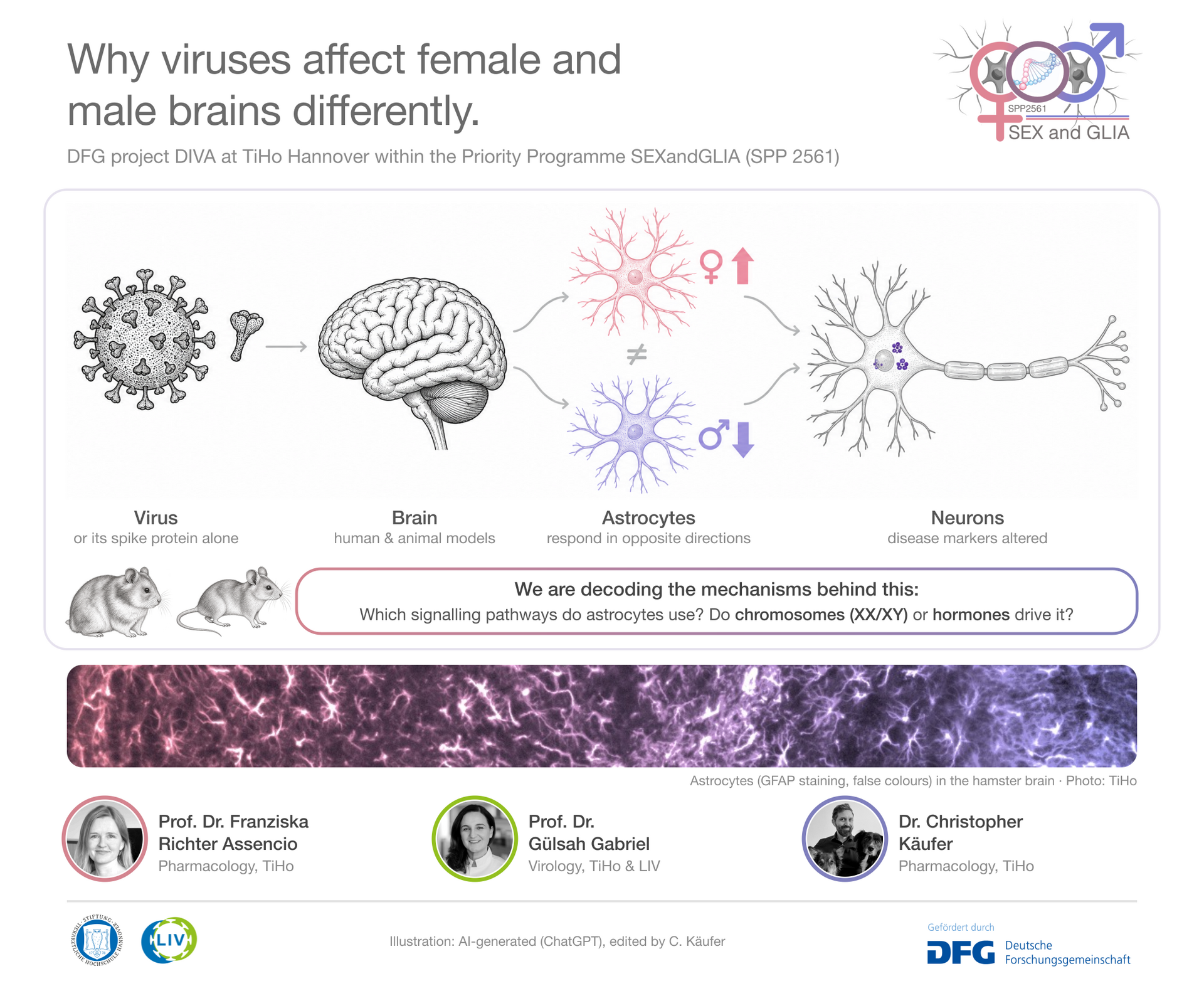
Men are more prone to severe acute COVID-19, while women more often develop persistent neurocognitive symptoms afterwards. Our preliminary data show that SARS-CoV-2 infection in Syrian hamsters causes sex-dependent neuroinflammation. The viral Spike S1 protein alone triggers astrocyte responses in mice that often run in opposite directions in the two sexes.
Combining hamster infection models, S1 challenge in mice, spatial transcriptomics, astrocyte-specific translatomics and the Four Core Genotypes model, we will determine whether sex chromosomes (XX/XY) or hormones drive these differences. We will also test whether they explain neurological disease after viral infection.
More about the Priority Programme: https://www.uni-saarland.de/en/researchers/spp2561/wissenschaftlicher-fokus.html
Project abstract
Astrocytes, the brain’s most abundant glial cells, carry inflammatory signalling machinery and sex hormone receptors, and may respond differently to viruses and viral proteins in males and females. Although sex strongly influences neurological disease risk and outcome, the contribution of astrocyte-specific inflammatory pathways remains unknown: a gap DIVA addresses within SPP 2561. Men are more prone to severe acute COVID-19, while women more often develop persistent neurocognitive symptoms afterwards. Our preliminary data show that SARS-CoV-2 infection in Syrian hamsters causes sex-dependent neuroinflammation, microglial activation, proteinopathy such as alpha-synuclein, and altered hormone receptor expression in the brain, despite absent viral replication there. Purified SARS-CoV-2 Spike S1 protein alone elicits astrocyte responses in mice that often run in opposite directions between sexes, accompanied by neuronal damage and olfactory loss, suggesting glia-to-neuron signalling.
We hypothesise that astrocyte-intrinsic inflammatory responses to viruses and viral proteins are sex-specific, and drive the sex differences in post-viral neurological disease. Three work packages combine BSL-3 hamster infection models with S1 protein challenge in mice. We will apply immunohistochemistry, spatial transcriptomics and astrocyte-specific RiboTag translatomics, and conditional astrocyte knockout mice to identify sex-specific pathways. Astrocyte–neuron interactions will be assessed by neuropathology and behavioural phenotyping. Comprehensive endocrinology, including brain hormone receptor expression, and the Four Core Genotypes model will separate sex chromosome (XX vs. XY) from gonadal steroid hormone effects.
DIVA will establish whether sex-specific astrocyte immune responses drive brain disease after viral infection, opening routes to targeted therapies, and all datasets will be shared within the SPP 2561 consortium.