Project title
Development of strategies to mitigate conflicts between fisheries, species conservation, and the Eurasian otter (Lutra lutra) in Schleswig-Holstein
| Project data | |
|---|---|
| Project leader: | Prof. Prof. h. c. Dr. Ursula Siebert |
| Scientific staff: | Dr. Kai Sören Lehmann, Dr. Andreas Ruser, Dr. Tobias Schaffeld, Janina Büntge |
| Project term: | April 2026 - December 2028 |
| Sponsorship: | Ministry of Energy transition, climate protection, environment and nature (MEKUN) |
Project description
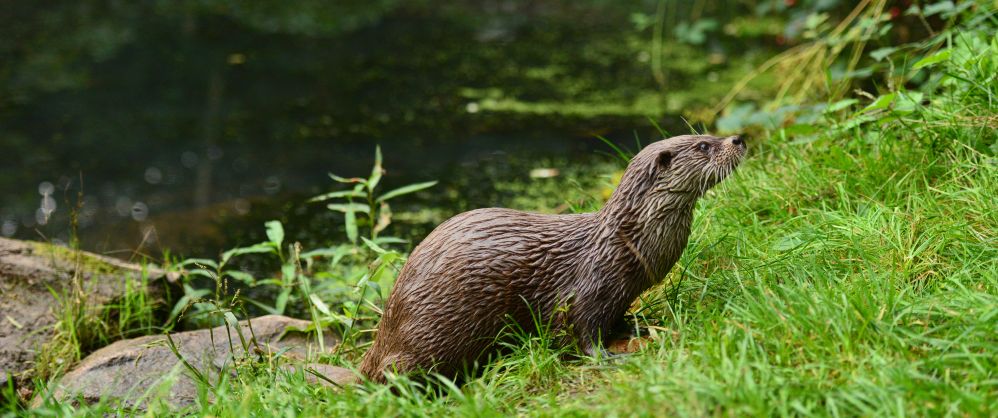
The Eurasian otter (Lutra lutra) is a top predator native to Germany’s freshwater habitats and thus occupies a special position within aquatic ecosystems. As an indicator species for habitat degradation and threats to biodiversity, it plays a vital role in nature conservation and species protection. Historically, the 20th century saw a massive decline in populations, caused by habitat loss, environmental pollution and direct persecution. Thanks to targeted species and habitat conservation measures, populations in Western Europe, including Germany, have been able to recover.
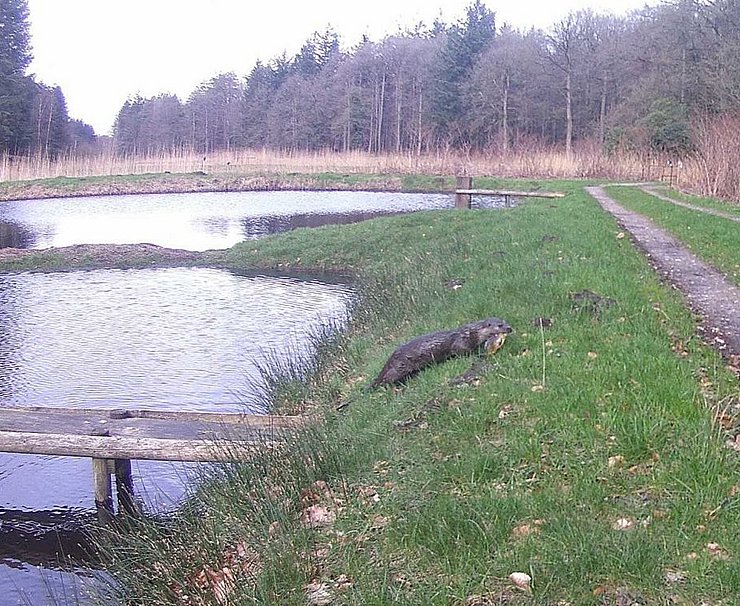
However, the recovery of populations has been accompanied by a resurgence of conflicts over resource use. Otters are opportunistic hunters and are often perceived as competitors for food by the pond farming and inland fishing industries. Added to this is a significant risk posed by road traffic, which is one of the leading causes of death for otters in Germany. Against this backdrop, there is an increased need for concrete management measures.
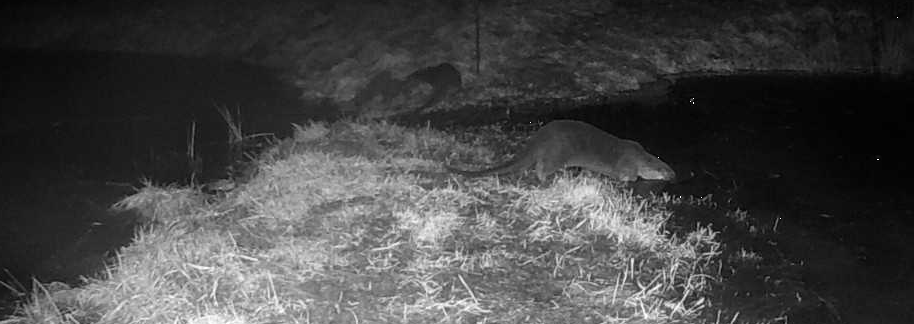
In a previous project, the use of camera traps and faecal analyses provided insights into the habitat use, diet and reproductive potential of the Eurasian otter in Schleswig-Holstein. This baseline data demonstrates the species’ growing importance and highlights areas of conflict in various sectors; however, it is insufficient to conclusively assess the potential for conflict with fish farming and endangered fish species, or the risks posed by road crossings, nor to develop solution strategies that comply with species conservation requirements.
A key shortcoming is the current lack of individual-level, high-resolution data on habitat use and behaviour. Previous telemetry approaches have predominantly been invasive or associated with animal welfare risks arising from capture and anaesthesia. New non-invasive methods for attaching transmitters (e.g. fur adhesives or Velcro-based systems) have been tested internationally, but not yet in Germany or in the context of conflict assessment. Recent studies highlight possibilities for tagging wild animals in their natural habitat without capturing them, thereby enabling us to learn more about their natural behaviour.
Against this background, the proposed project addresses precisely these existing gaps in knowledge: through the development of non-invasive telemetry methods, individual-level data on habitat use, conflict use (fish ponds) and road crossings are to be collected for the first time. In parallel, the effectiveness of acoustic deterrent measures in fish farming will be investigated. The project will thus make a direct contribution to the development of practical management strategies that take into account both species conservation requirements and the needs of the fish farming industry.
Research questions and project objectives:
- Can otters be fitted with telemetry tags without being captured?
- Can individual-level telemetry data be used to accurately assess the potential for conflict posed by Eurasian otters in fish pond farming?
- Which individual otters use fish ponds, how frequently do they do so, and how can this information be used to develop targeted conflict management strategies?
- How great is the risk to otters from road crossings in Schleswig-Holstein, and at which hotspots can protective measures be implemented?
- Can acoustic deterrents be used effectively to keep otters away from fish ponds without negatively affecting their behaviour in adjacent habitats?
Development and testing of non-invasive telemetry methods
A key prerequisite for assessing the potential for conflict between otters and fish farming, as well as the risks posed by road crossings, is the availability of high-resolution, individual-level movement and habitat data. Previous telemetry methods used on otters have predominantly been invasive, such as intra-abdominal implants, or have involved risks to animal welfare, for example through harness systems that can become entangled in vegetation. New, non-invasive methods are required to collect data suitable for practical application.
The project therefore aims to develop and test innovative methods for attaching telemetry transmitters that do not require trapping or surgery.
Individual-based assessment of conflict and risk potential
Using these new methods, we can for the first time determine whether and to what extent individual otters use fish ponds, how regularly such use occurs, and whether recurring patterns can be identified. This enables a nuanced assessment: it is not the entire population, but only certain individuals that cause conflicts. On this basis, targeted and efficient management measures can be developed that meet both the requirements of pond farming and the needs of species conservation.
At the same time, telemetry data is being used to assess the risk posed by road crossings. The high-resolution movement data allows us to identify hotspots for crossings. This provides, for the first time, a reliable basis for the spatially targeted planning of specific protective measures, such as crossing aids or guidance systems.
Evaluation of acoustic deterrent measures
A second area of focus is the development and testing of acoustic deterrent methods designed to keep otters away from specific conflict areas. The aim is to keep otters away from fish ponds without adversely affecting their behaviour in neighbouring habitats or impacting other species (fish, birds, amphibians).
The evaluation involves controlled trials in fish farming, during which it is recorded whether the acoustic signals deter the animals from entering the ponds or hunting there. To this end, densely stocked ponds are exposed to acoustic warning devices during the winter and monitored using camera traps. The aim is to determine the effects on the animals’ presence and behaviour. To assess effectiveness, control ponds in which no acoustic warning devices are used are also sampled.
Furthermore, the aim is to test whether this method can also be applied to time-limited and ecologically sensitive situations, for example during salmon spawning seasons, when conflicts are more likely to arise. Through the targeted management of deterrence measures, the aim is to develop a flexible, affordable and practical solution for conflict-prone regions.
Expected results and contribution to management
The project will deliver practical results in two key areas of conflict: (1) the use of fish ponds and (2) the risks posed by road traffic. The innovative, non-invasive telemetry methods represent a significant methodological advance and enable the collection of high-resolution, reliable data that was previously unavailable.
The results make it possible to identify the causes of conflict in a nuanced manner, to develop targeted conservation and mitigation measures, and to evaluate their effectiveness. For the fish pond industry, this provides the basis for practical solutions to minimise economic losses; for species conservation, it offers the opportunity to reduce the risks posed by road traffic and to promote sustainable coexistence between humans and otters.
Overall, the project thus establishes the scientific and practical basis for an integrated management approach that reconciles the otter’s conservation status with the requirements of commercial fishing.
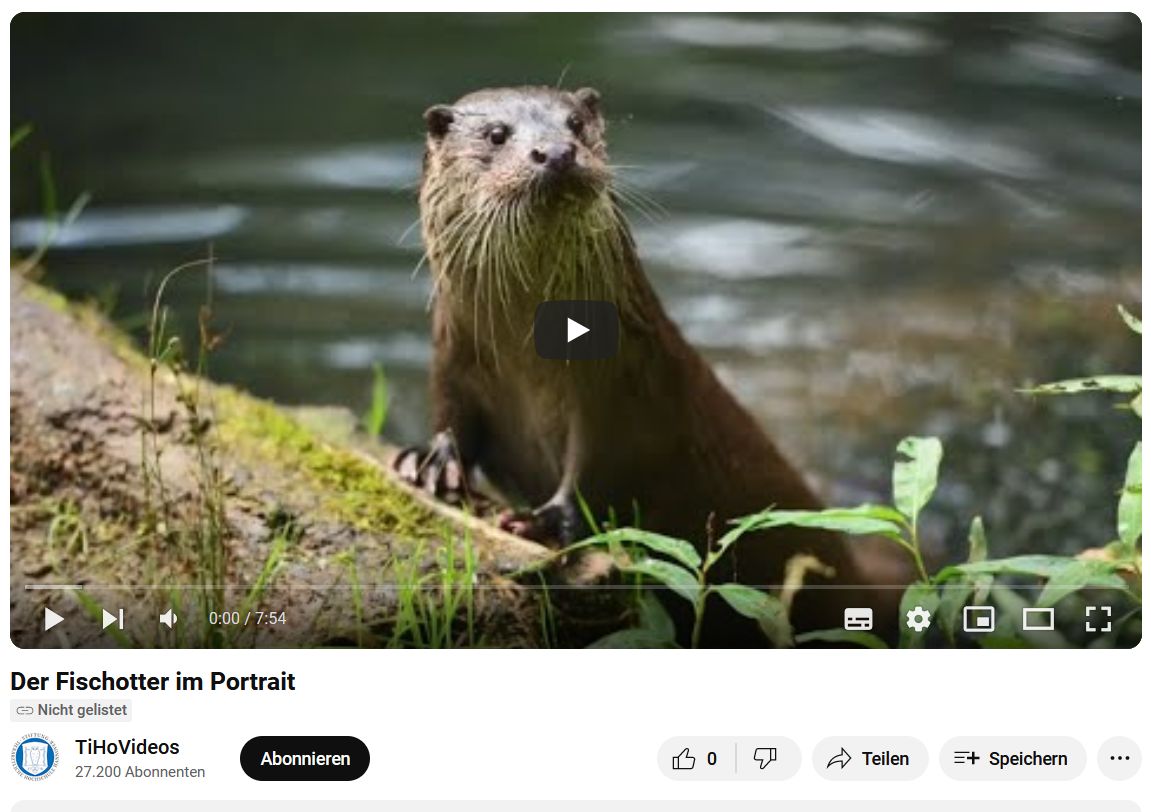
This film (only German version) presents research on otters. These mammals have been re-establishing themselves in Schleswig-Holstein for some time.
Der Fischotter im Portrait
Please note: Once you watch the video, data will be transmitted to Youtube/Google. For more information, see Google Privacy.
Contact person
Stiftung Tierärztliche Hochschule Hannover
Institute for Terrestrial and Aquatic Wildlife Research
Werftstr. 6
25761 Büsum
Dr. Tobias Schaffeld
Phone: +49 (0)511-8568164
e-mail schreiben