Staff
- Melanie Brede, PhD Tel.: +49 511 856 7629 E-Mail
- Yvonne Ambrecht, B.Sc. Animal care taker Tel.: +49 511 856 7334 E-Mail
- Marion Burmester, VMTA Tel.: +49 511 856 7236 E-Mail
- Karin Hustedt, Biology lab technician Tel.: +49 511 856 7281 E-Mail
- Paula Kasjan, animal takecarer Tel.: +49 511 856 7335 E-Mail
- Nadine Schnepel, BTA Tel.: +49 511 856 7529 E-Mail
- Katharina Wittenberg, PhD Student Tel.: +49 511 856 7330 E-Mail
Rumen microbiome, metabolism and simulation
In the rumen, bacteria, archaea, protozoa, and fungi form a symbiotic relationship with the host ruminant. Microbial enzymes enable the breakdown of plant components which are indigestible for animal itself, into short-chain fatty acids that the ruminant can utilize. Furthermore, these microorganisms convert dietary protein and other nitrogenous compounds into microbial protein, which serves as a protein source for the host animal. In total, microbial metabolites account for more than 70% of the ruminant's energy supply and 50% of its protein supply. Through this mechanism, ruminants play a significant role in transforming low-quality plant biomass into usable protein for human nutrition. Microbial fermentation also produces carbon dioxide and methane, which are expelled via eructation.
The ruminal microbial community is a highly complex system influenced by diet composition, management practices, environmental conditions, and animal genetics. Both, the overall structure of this microbial community and the presence of specific microorganisms are closely linked to the animals’ productivity, susceptibility to disease, and emission levels. A precise understanding of how diet, feed additives, and other external factors affect these microorganisms - as well as the functional interactions among the microorganisms themselves - contributes to maintaining animal health, increasing productivity, and reducing emissions from livestock ruminants.
Main research areas
Pathophysiology of the Rumen
Subacute ruminal acidosis (SARA) is a key focus of our research. To study this, we have established various in vitro models. (https://doi.org/10.3389/fmicb.2020.01813)
The Rusitec system also allows for the investigation of pathogenic agents or potentially toxic substances and their effects on the rumen microbiome. (https://doi.org/10.1371/journal.pone.0192256)
The Rumen and the Environment
During microbial fermentation in the rumen, hydrogen and CO2 are produced, which are then metabolized into methane by methanogenic archaea. Methane released from the rumen accounts for a significant portion of greenhouse gases originating from agriculture. Using the Rusitec model, we investigate various strategies to reduce methane production. (https://doi.org/10.3389/fmicb.2021.691502)
At the same time, environmental factors—such as global warming—exert a strong influence on the rumen microbiome and the function of the rumen in ruminants.
Technical Applications of rumen microorganisms
Rumen microorganisms possess an exceptional array of enzymes for breaking down plant fibres, which can be harnessed for use in technical processes. (https://link.springer.com/article/10.1007/s12155-023-10667-7)
Methods
In vitro systems
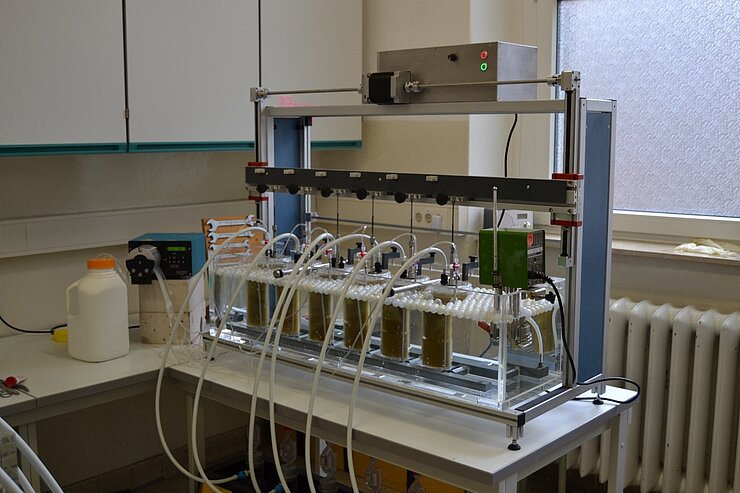
•Rusitec: We operate 2 Rusitec systems with atotal of 12 fermenters. In addition to fermentation parameters (pH, redox potential, SCFAs, NH3-N, lactate), these systems allow for the investigation of gas production, digestibility, microbiome and metabolome, or specific microorganisms.
•Batch experiments: Gas-tight fermentation vessels are available for short-term studies (up to 48–72 hours).
Analyses
Gas chromatography: A key feature of microbial fermentation processes is the production of short-chain fatty acids (SCFAs). A GC-2025 (Shimadzu) is available for the analysis of short-chain fatty acids in rumen or intestinal contents.
Photometric methods (for urea, NH3-N, and lactate)
Isolation of microbial DNA
Real-time PCR: Using specific primer pairs, we are able to analyse total bacterial counts, specific taxa, or the expression of particular genes (e.g., mcrA-gene). Two chemical approaches are available for quantification via real-time PCR: TaqMan probe-based chemistry and SYBR Green dye-based chemistry.
Cooperations
•Institute for Animal Nutrition Tierernährung, University of Veterinary Medicine Hannover, Hanover
•Institute of Sanitary Engineering and Waste Management, Leibniz University, Hanover
•Lehr- und Versuchsanstalt für Tierhaltung, Hofgut Neumühle, Bezirksverband Pfalz
•AG Selberherr, Centre for Food Science and Veterinary Public Health, Clincal Department for Farm Animals and Food System Science, University of Veterinary Medicine, Vienna, Austria
•Department of Resource Recovery and Building Technology, Faculty of Textiles, Engineering and Business (including The Swedish School of Textiles), University of Borås, Borås, Sweden
Interested in cooperating?
We offer:
•Measurement of SCFA, ammonia-N or lactate in rumen contents or ingesta
•In vitro experiment using the rumen simulation technique
•Further options available upon request
Contact: melanie.brede@tiho-hannover.de