One Health contra Influenza (OHcI)
The overarching objective of the collaborative research network (consisting of the partners: University of Veterinary Medicine Hannover, Institute of Virology; Ostfalia University of Applied Sciences, Faculty of Civil and Environmental Engineering; Leibniz University Hannover, Institute of Sanitary Engineering and Waste Management) is to investigate the interconnectedness of human, animal, and environmental health according to the One Health concept, and to develop a blueprint using the example of highly pathogenic avian influenza viruses (HPAIV). To date, testing for HPAIV is generally only conducted on an event-driven basis (suspicion of avian influenza, illnesses in livestock, deceased wildlife), which leads to a biased data situation. In contrast, this project will establish systematic, general monitoring independent of suspected cases ("unbiased") under holistic consideration of animals, humans, and the environment, examining the entirety of Influenza A viruses (IAV) alongside HPAIV.
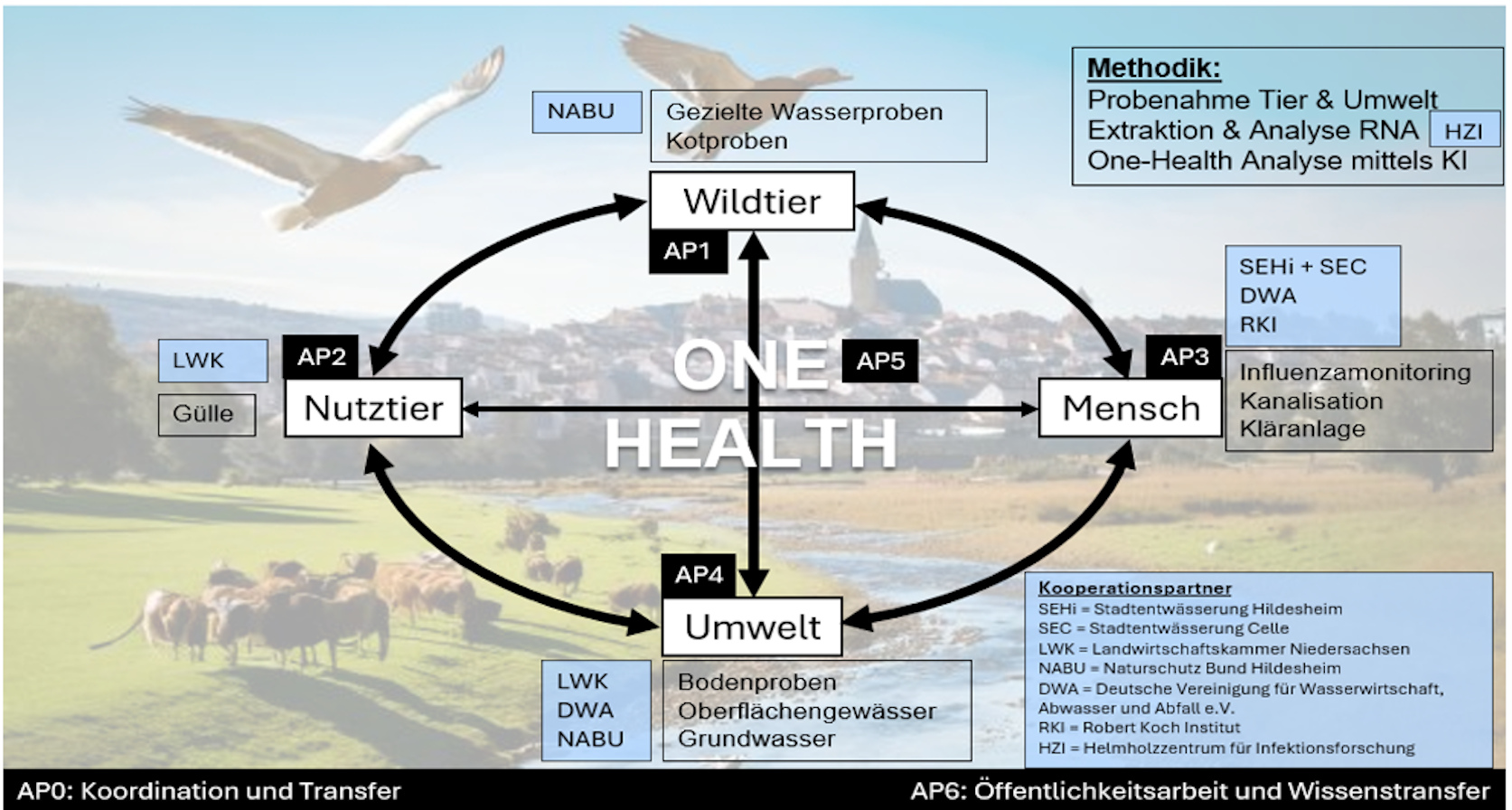
The project investigates the introduction of influenza viruses into the environment by humans, wildlife, and livestock (Figure). A cornerstone of the project is mapping infection pathways to enable the implementation of faster and more precise protective measures. Samples will be examined via virological analysis for IAV HxNx; positive findings will be subsequently typed and, if applicable, analyzed for HPAIV such as H5N1. To investigate potential transmission routes and the fate of excreted viruses in the environment, other zoonotic pathogens - such as rotaviruses and hepatitis E viruses, as well as other viruses present in livestock populations - will be considered as virological reference parameters. This ensures the successful execution of the project even in the event that HPAIV or other influenza viruses are not detected during the project term. If HPAIV (including H5N1) is detected within the project duration, the samples will be analyzed using whole-genome sequencing. The goal is to detect predominant mutations and to monitor the development of mutations in subsequent positive findings.
The subproject OHcI-TiHo being carried out by the University of Veterinary Medicine Hannover (TiHo) focuses, in close collaboration with the other two consortium partners, on the persistence of viruses excreted in bird droppings on agricultural land and in surface waters, such as ponds and lakes (AP1 “Wildlife”). In this context, both year-round resident wild birds and migratory birds are taken into account. To examine the introduction of influenza viruses and other viruses by livestock, fecal and swab samples as well as slurry or manure samples from various animal species - such as pigs, cattle, chickens, turkeys, and ducks - will be collected and analyzed in an additional work package (AP2 "Livestock"). The subprojects of the two network partners primarily deal with the sampling and analysis of wastewater and water bodies. In a further work package, the information gained from all subfields will be linked and merged using AI-based analyses.