FOUNDING AND DEVELOPMENT OF THE INSTITUTE OF BIOCHEMISTRY
The present-day Institute of Biochemistry at the University of Veterinary Medicine Hannover was founded in 1965 under the name “Institute of Physiological Chemistry.” Its first director was Prof. Niesar. Initially, the laboratories and offices were located in the building of the Institute of Physiology at Bischofsholer Damm. Prof. Jürgen Schole succeeded Prof. Niesar.
In 1977, the institute moved to the newly constructed Building 218 at the Bünteweg campus in Hannover-Kirchrode. At that time, the institute consisted of three professors, five research assistants, seven technical assistants, and several doctoral candidates. In addition to teaching biochemistry to veterinary students, research focused on metabolic processes of carbohydrates and lipids in animals. After the retirement of Prof. Schole, Prof. Hans-Peter Sallmann served as acting director from 1992 to 1997.
In 1997, Prof. Dr. Hassan Y. Naim, originally from Beirut, Lebanon, was appointed to the C4 Professorship of Biochemistry and became head of the institute. Prior to this, he had conducted research at the Universities of Bern and Lausanne, as well as at the Southwestern Medical Center of the University of Texas in Dallas, focusing in particular on protein transport and sorting. His work laid the foundation for the current understanding of genetically determined enzyme deficiencies, such as sucrase-isomaltase and lactase deficiency. He later led a junior research group funded by the German Federal Ministry of Education and Research at the University of Düsseldorf on these topics.
With Prof. Naim’s appointment, the institute expanded its research scope to include molecular mechanisms of protein and membrane transport under physiological and pathological conditions. Key research areas included gastrointestinal diseases, lysosomal storage disorders, and prostate cancer. Teaching was also expanded to cover the entire compulsory and elective curriculum in biochemistry for veterinary students, as well as courses in cell and molecular biology and pathobiochemistry for students of biology and biochemistry.
In 2004, Prof. Sallmann retired. In the same year, Prof. Bernd Otto from the Fraunhofer Institute joined the institute as an associated member. As the holder of a professorship in biotechnology and molecular biology established by the state of Lower Saxony, he supported teaching activities until his retirement.
In 2010, Dr. Maren von Köckritz-Blickwede joined the institute following research stays at the University of California, San Diego, and the Helmholtz Centre for Infection Research in Braunschweig. She initiated numerous new projects on the biochemical analysis of infections and immune defense, with a particular focus on phagocytic extracellular DNA traps. In 2015, she was appointed to the W2 Professorship “Biochemistry of Infections” and took over the newly established research group “Infection Biochemistry.”
In September 2020, the institute was endowed with an advance professorship in Molecular and Clinical Infectiology. This position had been created in anticipation of the planned succession of Prof. Dr. Naim, who retired on September 30, 2022. Since then, Prof. Naim has remained closely associated with the institute in a scientific capacity, particularly as an active researcher and mentor for young scientists.
The appointment to the advance professorship was accepted by Assistant Professor Dr. Gisa Gerold, a virologist. She assumed leadership of the institute in October 2022 and held the position until September 2024, before accepting a professorship in virology at the Medical University of Innsbruck.
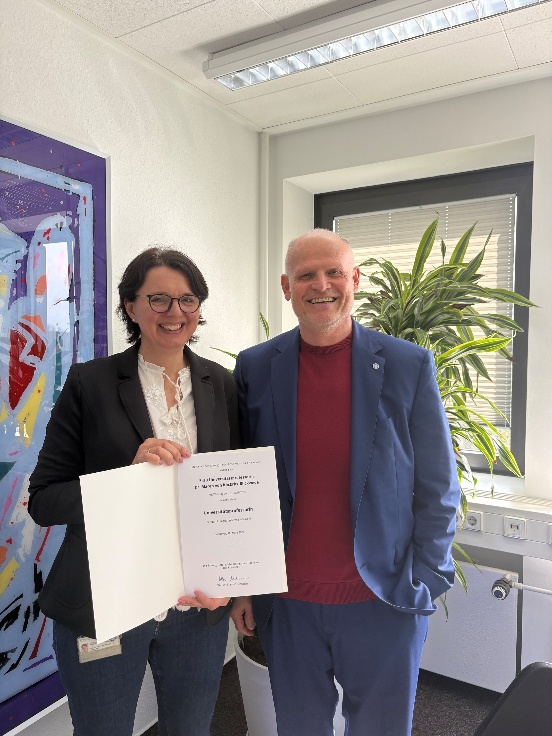
Since April 1, 2026, Prof. Dr. Maren von Köckritz-Blickwede has been appointed to the W3 Professorship of Biochemistry and has taken over as head of the Institute of Biochemistry. Under her leadership, the institute’s research focuses on the influence of lipid metabolism and hypoxia on the immune response, as well as on host-pathogen interactions.
Urkundenübergabe durch den Präsidenten Herrn Professor Dr. Osterrieder